Why is deep stretching vacuum forming always "thin here and thick there"?
temps: September 01, 2026
In the thermoforming industry, deep-drawn food containers, fresh meat trays and deep-cavity products have always been the best test of manufacturing craftsmanship. With the same sheet material, some factories produce finished parts with uniform wall thickness and flawless appearance, while many others face consistent issues. Products can be formed barely qualified, yet suffer from thin side walls, insufficient bottom material, corner thinning and surface marks, resulting in low and unstable yield rates.
Most operators tend to repeatedly adjust heating temperature, vacuum time and mold temperature when defects occur. However, the improvement is limited. The core difficulty of deep-draw thermoforming is not whether the sheet can be molded, but how to control material flow and achieve uniform material distribution. A critical variable often overlooked is Plug Assist.
1. Shallow drawing relies on vacuum; deep drawing relies on material distribution
Shallow tray thermoforming follows a simple principle. After being heated and softened, the sheet fits the mold via vacuum suction with minor stretching and even material distribution, rarely causing thickness deviation.
In contrast, deep-drawn products require flat sheets to be stretched into 3D deep-cavity structures. Relying solely on vertical vacuum pulling leads to typical defects: thick rim, thin bottom and material shortage at corners. Vacuum force stretches the material excessively in deep and corner areas, causing unbalanced wall thickness.
Plug Assist solves this fundamental problem. It pre-pushes the softened sheet into the mold cavity before vacuum forming and completes pre-distribution of the material. The subsequent vacuum process only serves for fitting and shaping without extreme stretching, fundamentally improving uneven wall thickness on side walls, bottoms and corners.
2. Plug Temperature: The Critical Threshold of Deep-Draw Process
The plug is not merely a structural component, but a core process part that controls temperature, material flow and surface quality. Direct contact between the plug and high-temperature soft sheet means even tiny temperature deviations will cause obvious quality defects.
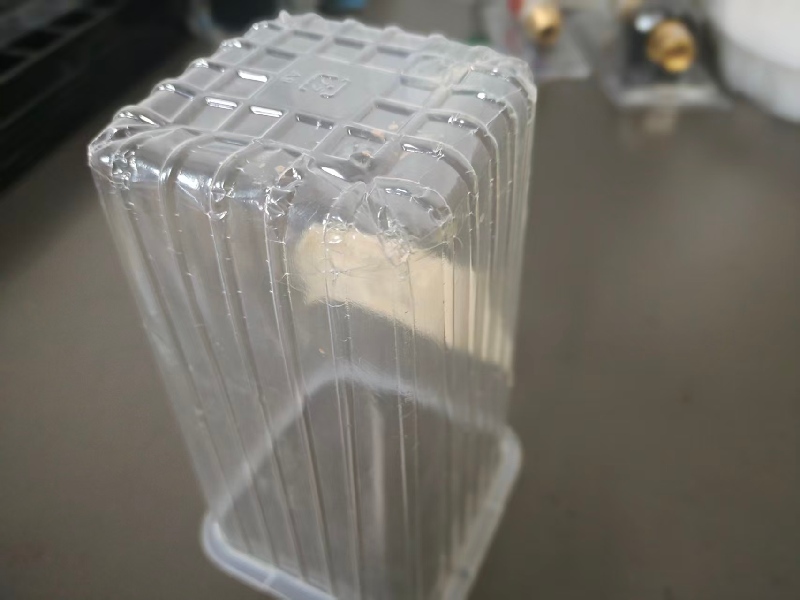
1. Low Plug Temperature: Chill Mark
A cold plug rapidly dissipates local heat from the sheet, causing premature cooling and hardening of the contact area and sharply reducing ductility. The visible surface marks essentially result from unsynchronized material stretching, directly leading to uneven wall thickness and unstable structural strength.
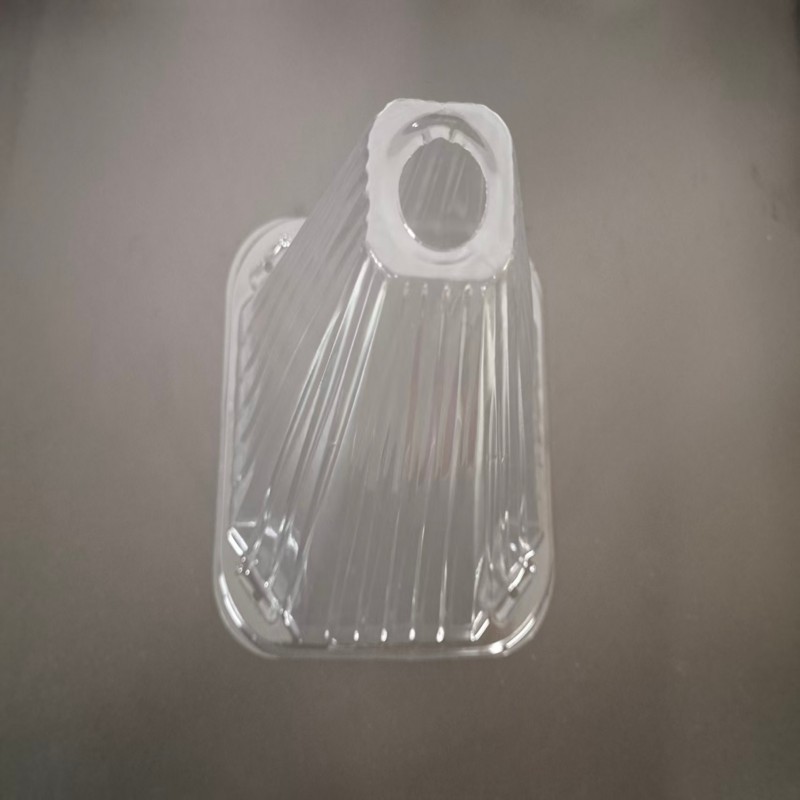
2. High Plug Temperature: Mark-off Defects
Higher plug temperature does not equal better performance. Excessively high temperature causes the soft sheet to adhere to the plug surface, resulting in drawing lines, scratches and dents during demolding, which severely reduces appearance yield and production stability.
3. Industry Consensus: Plug Process Defines Product Quality Ceiling
Deep-draw thermoforming has a typical process contradiction: low temperature causes chill marks, while high temperature leads to adhesion defects. A mature and stable mass production process requires plug temperature to be controlled within the optimal range, which avoids sudden sheet cooling and uneven stretching, and ensures smooth demolding with zero surface defects.
Classic thermoforming studies have long verified that for copolymer sheet deep drawing, plug material selection and constant temperature accuracy exert a far greater impact on yield rate than conventional heating and vacuum parameters. This principle is still fully applicable to deep-draw production of food-grade PP, PET and PS sheets.
For high-standard products such as fresh meat trays, deep food boxes and sealed containers, conventional equipment parameters only guarantee basic forming. Precise plug process debugging is the core factor that differentiates product quality in the industry.


 français
 English
 العربية