In the field of degradable polymers, researchers and enterprises are constantly pursuing new bio-based materials and high-end modification technologies, yet they often overlook a core element — starch.
Although it seems to be the most traditional and ordinary natural powder, starch is the most widely applied, thoroughly studied, and industrially mature bio-based raw material in the degradable material industry. Meanwhile, it is also one of the most problematic and challenging materials for modification.
Many practitioners fall into a misunderstanding: believing that a higher starch loading rate is always better, and blindly pursuing high filling and low cost.
However, experienced industry professionals understand that the core of starch modification is never simply "adding more starch". Instead, it is enabling starch to stably, uniformly and controllably integrate into PLA, PBAT and PBS polyester systems, so as to achieve three core goals simultaneously: cost reduction and efficiency improvement, increased bio-based content, and precise regulation of degradation behavior.Among various bio-based powders such as bamboo powder, straw powder and coffee grounds powder, starch has always occupied a core position and become a key variable of degradable materials, mainly due to its unique industrial value and excellent compatibility.
Five Core Advantages Establishing Starch’s Industrial Necessity
Starch is derived from common crops such as corn, cassava, potato and wheat. It features a mature and stable supply chain as well as transparent and controllable raw material prices, making it a veritable inclusive bio-based raw material.
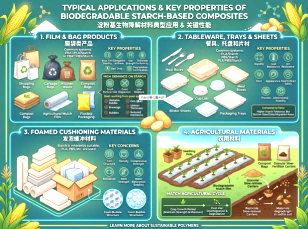
Currently, the biggest industrial bottleneck of degradable resins including PLA, PBAT and PBS is high raw material cost, which restricts the large-scale popularization of disposable consumables. The addition of starch can effectively replace part of polyester resins and greatly reduce the overall raw material cost.Especially in price-sensitive scenarios such as shopping bags, garbage bags, compostable bags, disposable tableware and packaging trays, starch-based composite systems are one of the optimal solutions that balance cost performance and compliance.Nevertheless, it must be clearly recognized that cheap starch does not mean cheap starch-based materials. Links including raw material drying, plasticization modification, compatibilizer matching, granulation processing and performance compensation will generate implicit costs. Poor process control will lead to higher overall costs and lower product quality despite high filling rates.
Natural Degradability and Improved Bio-based Performance
As a natural polysaccharide polymer, starch can be decomposed by natural microorganisms and has inherent green degradability. Integrating it into polyester composite systems can significantly increase the natural biomass proportion of materials, consolidate the advantages of product bio-based certification, and adapt to the current green environmental protection industrial trend and market demand.
The classic PBAT/PLA/starch system serves as an optimal matching model: PBAT provides material toughness, PLA endows products with rigidity and basic bio-based properties, and starch further increases bio-based content and optimizes the cost structure. This is also the mainstream formula logic for current film bags, packaging and catering consumables.
Active Degradation Regulation Beyond Ordinary Fillers
Most fillers only achieve simple filling and modification, while starch acts as a functional component for degradation regulation.Starch has strong hydrophilicity, which makes it easy to absorb water, swell and be eroded by microorganisms. In new composite materials, the starch phase undergoes preferential hydrolysis, swelling and microbial degradation, forming tiny pores and channels inside the material. These pores further guide the penetration of water, oxygen and microorganisms into the deep layer of the material, accelerate overall disintegration and degradation, and realize precise regulation of degradation efficiency.Key reminder: Starch can accelerate material disintegration, but it cannot replace standardized testing and evaluation such as industrial composting, home composting and soil degradation, nor can it be the sole basis for compliance judgment.
Multi-process Adaptability and High Modification Flexibility
The compatibility and plasticity of starch are incomparable to other bio-based powders, and it is applicable to all processing systems of degradable materials:
It can be directly filled with raw starch or prepared into thermoplastic starch (TPS) to optimize processing performance. Its interfacial properties can be improved through chemical and physical modification, and it can be made into special starch masterbatches to enhance dispersion stability. Meanwhile, it can be blended and modified with PLA, PBAT and PBS, and compounded with powders such as cellulose, calcium carbonate and talc to achieve synergistic effects, meeting the performance requirements of different products.
Solid Industrial Foundation and High Practicability
Compared with emerging bio-based powders such as bamboo powder, straw powder and fruit residue powder, starch has a more mature research system, modification technology and mass production experience. In particular, after years of industrial iteration, the PBAT/PLA/starch composite system has formed complete process parameters, formula systems and practical solutions with higher fault tolerance and better mass production stability.
However, maturity does not mean simplicity. Starch with different sources, particle sizes and moisture contents, matched with different plasticization processes and compatibilizer systems, will result in completely different mechanical properties, processing stability and degradation effects of finished products, which is the core difficulty of starch modification.
The Essence of Starch: An Active Polymer Rather Than an Inert Filler
Many enterprises fail to produce high-quality starch-based degradable materials due to a cognitive error: treating starch as an ordinary inert filler rather than a functional natural polymer.Starch is composed of amylose and amylopectin. Its particles have a multi-level microstructure with a large number of active hydroxyl groups on the surface. These hydroxyl groups are the core characteristics of starch and the root cause of all modification difficulties.On the one hand, a large number of hydroxyl groups endow starch with strong hydrophilicity and high water absorption, making it prone to water absorption, foaming and molding defects during processing. On the other hand, polyester resins such as PLA, PBAT and PBS are mostly weakly polar and hydrophobic, resulting in poor interfacial compatibility with strongly polar starch.Simple blending and filling cannot realize effective bonding between starch particles and polyester matrix, and interfacial debonding is likely to occur. When the material is stressed, starch particles become stress concentration points, which directly lead to a significant decline in product strength, toughness and elongation at break, causing problems such as brittleness, fracture and poor weather resistance.
Core Industry Truth: Starch Modification Focuses on "Interfacial Optimization"
To summarize the application logic of starch in the entire degradable material industry, the core can be concluded in one sentence:
The real technical barrier is never whether starch can be added, but whether starch can be modified to achieve stability, uniform dispersion and firm interfacial bonding.
The quality of starch-based composite materials does not depend on the starch addition amount, but on four key indicators: effective plasticization, uniform dispersion, complete coating and efficient compatibility.
Through precise modification, the hydrophilic defect of starch is eliminated and the interfacial barrier between starch and polyester is broken, realizing the perfect integration of the two originally incompatible systems. It can truly achieve cost reduction without quality degradation, higher bio-based content without performance loss, and accelerated degradation without affecting service stability.
This explains why starch, seemingly basic and ordinary, has always been a core raw material that tests processing technology and differentiates product quality in the degradable material industry.
In the future, the competition of degradable materials will shift from "competing for raw materials and formulas" to "competing for fine modification, interfacial technology and stable mass production capacity", and starch modification is the core battlefield of this refined competition.
What applications are suitable for starch based powders?


 français
 English
 العربية