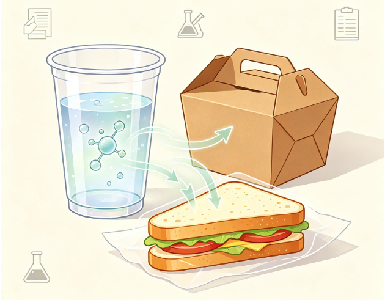
A PLA transparent cup for salad, a PBAT-coated takeout paper box, and a piece of degradable cling film wrapped around a sandwich - when packaging materials come into direct contact with food, the label "degradable" no longer merely concerns waste disposal, but raises another question: Will the chemicals in this film migrate into the food I eat? This question has a strict answer framework at the regulatory level, but there is a significant information gap at the actual product and consumer awareness levels. In this issue, we will dissect the chemical migration mechanism of degradable materials in contact with food, the main risk substances, and the regulatory systems of the FDA and EFSA - allowing you to understand a food contact material compliance statement and know where the substantive protection lies and where formalism prevails.
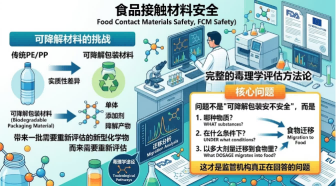
The safety of food contact materials is a specialized field with its own comprehensive toxicological assessment methodology. The introduction of degradable materials does not disrupt this field, but rather brings about a new batch of chemicals that require re-evaluation—due to their monomers, additives, and degradation products having substantial differences from traditional PE/PP.
- Chemical migration: The physical process from packaging to food
- The migration of chemicals from packaging materials to food is a physicochemical process driven by concentration gradients, and it has no direct correlation with whether the material is "degradable" - traditional PE packaging also faces migration issues (such as antioxidants and slip agents). However, degradable materials introduce a new batch of potential migrating substances, and their migration behavior varies depending on the material structure.
- The main factors affecting migration rate and migration amount are:
- contact temperature
- Temperature is the strongest driving factor for migration rate. The migration amount of the same material can vary by several tens of times between room temperature (23℃) and microwave heating (above 100℃). The glass transition temperature (Tg) of PLA is about 55–60℃. Beyond this temperature, the molecular chain movement intensifies, and the migration rate rises sharply - this is the fundamental reason why PLA packaging is "not suitable for hot food", not just due to deformation, but also from the perspective of migration.
- contact duration
- The migration amount usually increases with prolonged contact time, with a rapid initial growth rate and gradually approaching equilibrium (diffusion reaching steady state). The migration amount corresponding to long-term storage (such as a shelf life of several months) and short-term exposure (1-2 hours for food delivery) may differ by orders of magnitude.
- Food Properties
- Fatty foods (oil, cheese) are typically the strongest migration-promoting media, as many organic small molecules are more soluble in lipids; acidic foods (juice, vinegar) may promote accelerated hydrolysis of certain degradable materials based on ester bonds, releasing monomers; aqueous food migration is usually milder. Therefore, regulatory testing stipulates several types of standard food simulants (distilled water, acetic acid solution, ethanol solution, vegetable oil).
- Material thickness and barrier layer design
- Migration is related to packaging thickness and molecular diffusion path length. Multi-layer composite structures (such as PBAT outer layer + functional barrier layer + food contact layer) can significantly reduce the migration of specific substances through the selection of inner layer materials. This is why degradable packaging typically appears in food contact applications as multi-layer composites rather than single layers.
Key risk substances: which chemicals warrant attention
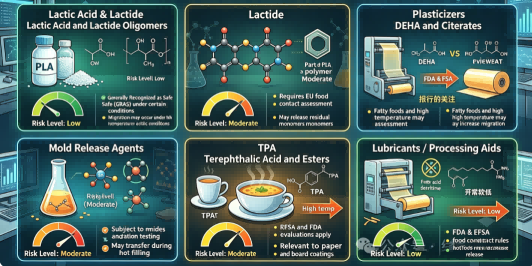
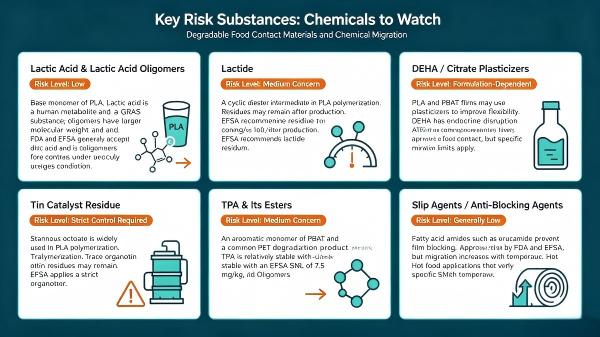
In degradable food contact materials, the chemicals of concern for migration risk assessment mainly come from four sources: polymer monomers, processing aids (additives), catalyst residues, and degradation products. The following are the substances of concern with the most substantial evidence in current literature:
FDA vs EFSA: Core Differences between the Two Regulatory Frameworks
Globally, biodegradable food contact materials primarily adhere to two regulatory frameworks: the 21 CFR system of the US FDA and the EU No 10/2011 regulatory system led by EFSA in the EU. These two frameworks exhibit significant methodological differences, influencing the selection of product compliance pathways.
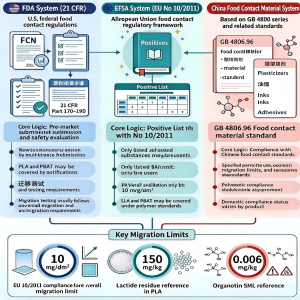
| Regulatory System |
Core Logic |
Strictness |
| FDA (21 CFR) |
Substance Inventory + Use Conditions |
Relatively flexible, enterprise-led |
| EFSA (EU 10/2011) |
Positive List + Unified SML |
Most conservative, highest barriers |
| China GB 4806 |
National Standard Inventory |
Aligns with EU but inventory lags |
Key Universal Migration Limit Benchmarks
10 mg/dm² Overall Migration Limit (OML) defined by EU 10/2011, equal to roughly 60 mg/kg food. This is a hard cap on the total volume of all migrating chemicals, regardless of individual substance SMLs.
150 mg/kg Maximum permitted lactide residue in PLA per EFSA rules. Exceeding this threshold raises risks of excess lactide migration into food and requires production process re-evaluation.
0.006 mg/kg food Migration limit for organotin compounds (e.g., stannous octoate). This is one of the strictest SMLs in food contact regulation, reflecting high regulatory concern over organotin endocrine disruption effects.


 français
 English
 العربية